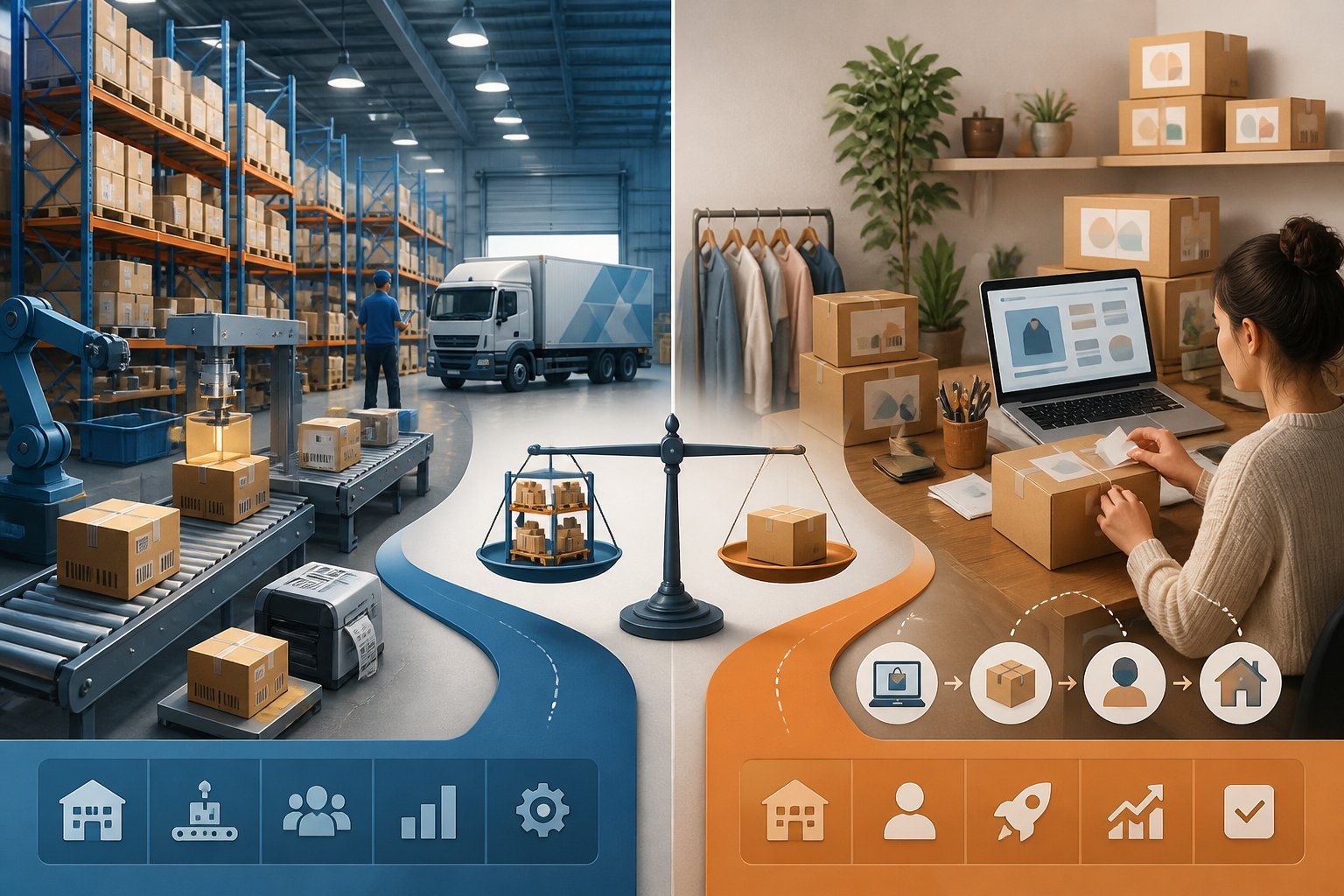
Starting an online business on Amazon means picking a fulfillment method, and the two most common choices are FBA and dropshipping. Let’s have a look at the comparison: Amazon FBA vs dropshipping. FBA works best if you want faster shipping, more customer trust, and less daily work, while dropshipping fits better if you have a small budget and want to test products before committing money. Both models can build a real e-commerce business, but they work in very different ways.
Amazon FBA vs dropshipping comes down to who stores the product, who ships it, and who pays for it upfront. With FBA, you send your inventory to Amazon and let them handle storage, shipping, and returns. With dropshipping, you never touch the product at all; your supplier ships it directly to the customer after they buy it from you. Your choice affects your costs, your control over product quality, and how much you can grow your business over time. This article breaks down FBA vs dropshipping so you can see the real differences in fees, risk, and daily work before you decide which one fits your goals.
Key Takeaways: Amazon FBA Vs Dropshipping
- FBA and dropshipping are two different ways to fulfill orders on Amazon, and each one changes how much work and money you need upfront.
- Your decision should depend on your budget, how much control you want over product quality, and how fast you want to grow.
- Understanding the fees, risks, and rules for each model helps you avoid costly mistakes as you build your online business.
How Each Fulfillment Model Works: Amazon FBA Vs Dropshipping
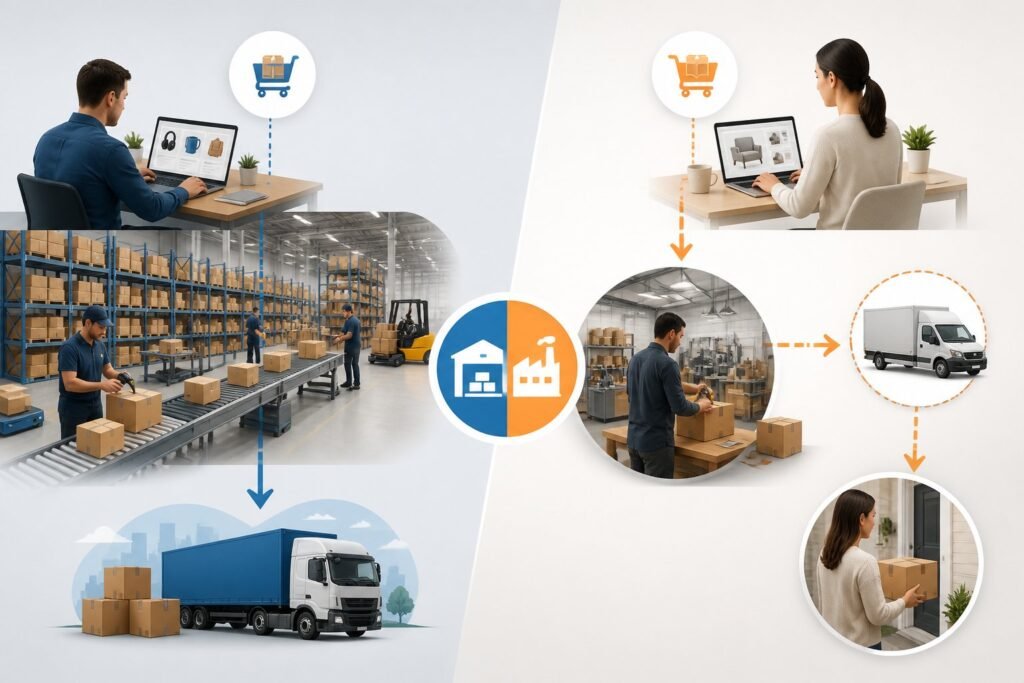
Amazon FBA and dropshipping handle inventory, shipping, and customer service in different ways. Amazon has strict rules for how each model must operate, so it helps to know the steps involved before you pick one.
How Fulfillment by Amazon Works
With FBA, you send your products to an Amazon fulfillment center before you make any sales. Amazon stores your inventory in its warehouses and takes care of picking, packing, and shipping each order.
When a customer buys your product, Amazon ships it and handles returns and customer service too. Your listing gets the Prime badge, which can boost trust and visibility with buyers.
You still act as the seller of record, but you give up direct control over how your product is packed and shipped. In exchange, you get faster delivery times and access to Prime customers, which can lead to more sales. You pay storage and fulfillment fees based on the size and weight of your products.
How Dropshipping Works
Dropshipping works in the opposite order. You list a product on your store or on Amazon before you own it or pay for it.
Once a customer places an order, you buy the item from your supplier or manufacturer at a lower price. The dropshipping supplier then ships the product straight to your customer.
You never touch the product yourself, and you don’t pay for inventory until after you’ve made a sale. This keeps your upfront costs low, but it also means you depend on your supplier for shipping speed and product quality. Your profit is the difference between what you charge the customer and what you pay the supplier.
Amazon Dropshipping and FBM Requirements
If you dropship on Amazon, you must follow Amazon’s dropshipping policy through Fulfilled by Merchant (FBM). Under FBM, you are responsible for packing and shipping orders yourself, or through a third party you hire directly.
Amazon requires that you:
- List yourself as the seller of record on all packing slips, invoices, and paperwork.
- Remove any packing slips, invoices, or other information that identifies a different seller or retailer (such as buying off another online retail store to ship directly to your buyer).
- Handle all customer returns, even if a supplier ships the product.
- Maintain strict account health metrics, including Amazon’s Valid Tracking Rate (VTR) and Late Shipment Rate (LSR).
You cannot buy products from another online retailer and have that retailer ship directly to your customer under its own name. Amazon sellers who break these rules risk account suspension. Following FBM requirements closely through Seller Central helps you avoid this while keeping your dropshipping business active.
Side-by-Side Comparison at a Glance: Amazon FBA Vs Dropshipping
Amazon FBA and dropshipping differ in cost, speed, and control. Here is how the two models compare across the areas that matter most to your bottom line.
Upfront Investment and Startup Costs
FBA requires real money before you make a single sale. You need to buy inventory in bulk, pay to ship it to Amazon’s warehouses, and cover storage fees while it waits to sell.
Dropshipping works the other way around. You don’t pay for a product until a customer buys it, so your startup costs stay low.
This makes dropshipping the safer entry point if you have a small budget or want to test an idea first. The difference in startup costs is one of the clearest ways to tell the two models apart. FBA fits sellers who already have capital and want to invest in proven products.
Inventory Ownership and Cash Flow
With FBA, you own the inventory the moment you buy it. If it doesn’t sell, that money is stuck on a shelf, and you still owe storage fees.
Dropshipping removes this problem entirely. You never hold stock, so there’s no risk of being stuck with products nobody wants.
This changes how you manage cash flow:
- FBA: Cash goes out first (buying bulk inventory), then comes back after inventory sells.
- Dropshipping: Cash comes in from the sale first, then goes out to pay the supplier.
Dropshipping keeps more cash on hand since you’re not paying for products in advance.
Shipping Speed and Customer Experience
Shipping speed is one of Amazon FBA’s strongest advantages. Products stored in Amazon’s warehouses qualify for Prime shipping, which means fast 1- to 2-day delivery times that customers expect and trust.
Dropshipping shipping times vary. If your supplier is overseas, delivery can take one to two weeks or longer, which can hurt customer satisfaction and threaten your Amazon account standing if orders arrive late.
This gap affects customer service too. Amazon handles returns and support for FBA orders, while dropshippers manage complaints, tracking issues, and refunds themselves. Slower delivery is one of the main reasons customers leave negative reviews for dropshipped orders.
Control, Flexibility, and Scalability
Dropshipping on an independent platform (like Shopify) gives you high control over your store branding, pricing, and customer relationships. However, dropshipping generic items on Amazon offers little to no brand control.
FBA limits custom packaging since Amazon controls the fulfillment experience, but it offers far stronger scalability once a product proves it sells well.
Here is how the two compare on growth:(Amazon FBA vs Dropshipping)
| Factor | Dropshipping | FBA |
| Brand control | High (Shopify) / Low (Amazon) | Moderate |
| Scaling speed | Moderate | Fast |
| Inventory risk | Low | High |
| Competition | High (many sellers, same products) | Moderate (Prime badge helps stand out) |
Many sellers test products through dropshipping first, then move winning items into FBA once demand is confirmed.
Costs, Fees, and Profit Margin Potential
Your costs and fees look very different depending on which model you choose, and this affects how much profit you actually keep from each sale. Amazon FBA involves upfront spending on inventory and ongoing storage costs, while dropshipping shifts most of your spending to marketing and advertising.
Amazon FBA Fees and Inventory Costs
With FBA, you pay for your product upfront at a wholesale price, then send it to Amazon’s warehouses. Amazon charges referral fees on each sale, which typically run between 8% and 15% of the item price depending on the category.
You also pay fulfillment fees for picking, packing, and shipping each order. On top of that, you owe monthly storage fees for keeping inventory in Amazon’s warehouses. Note that Amazon charges significantly higher monthly storage fees during peak holiday season in Q4 (October through December).
If your inventory sits unsold for too long, you get hit with long-term storage fees. This makes inventory management a real skill you need to learn, since unsold stock ties up your cash and cuts into your margins.
Dropshipping Operating Costs
Dropshipping skips warehousing costs entirely, since you never hold inventory. You only pay your supplier after a customer places an order, so your upfront costs stay low.
Your main expenses shift to your storefront platform fees, payment processing, and marketing. Customer acquisition cost becomes your biggest line item, especially if you rely on PPC advertising to drive traffic to your store.
Because you are buying single items rather than ordering in bulk, your product cost per unit is higher than what an FBA seller pays. This can shrink your margin on each sale, even though your overall financial risk is lower.
How to Calculate a Viable Product Margin
To find a viable margin, start with your selling price and subtract every cost tied to that sale. For FBA, subtract your wholesale price, referral fees, fulfillment fees, and a portion of your storage fees. For dropshipping, subtract your supplier cost, payment processing fees, and your average customer acquisition cost.
A simple way to check your numbers:
- Selling price minus product cost equals your gross margin.
- Gross margin minus fees and shipping equals your net margin before marketing.
- Net margin minus advertising spend equals your actual profit per sale.
Aim for a net margin that still leaves room for returns, refunds, and slow sales periods before you commit to scaling a product.
Product Sourcing, Testing, and Quality Control
How you find products and check their quality depends on which model you use. FBA sellers need data and capital before they buy, while dropshippers can test ideas fast with almost no risk.
Finding Products for Amazon FBA
Product research for FBA takes time and money. You need to find winning products before you buy inventory, since a bad choice can leave you with unsold stock.
Tools like Jungle Scout and Helium 10 help you check sales estimates, competition, and demand trends before you commit cash. Many sellers use these tools to spot niche products with steady demand and lower competition.
You also need to pick a sourcing method:
- Wholesale: Buy existing branded products in bulk.
- Private label: Work with a manufacturer to put your own brand on a product.
- Retail arbitrage: Buy discounted items in physical stores and resell them.
Each method has different costs and risks. Private labeling often takes the most upfront work but gives you control over your brand.
Testing Demand With Dropshipping
Dropshipping lets you test products without buying stock first. You can list an item, run ads, and see if customers actually want it before spending money on inventory.
This makes it easier to try trending products and niche items without financial risk. If a product doesn’t sell, you remove it and try something else. If it sells well, you have real data to support scaling it further, including moving it to FBA later.
Product testing with dropshipping works best when you track:
- Conversion rate on your store
- Cost per click from ads
- Customer feedback and return requests
These numbers tell you if a product is worth scaling or if you should move on to a new one.
Vetting Suppliers and Protecting Product Quality
Your supplier relationships directly affect your product quality and customer satisfaction. A dropshipping supplier who ships slowly or sends damaged items can hurt your store’s reputation, even if you never touch the product yourself.
Before working with any supplier or manufacturer, check their reviews, request samples, and confirm their shipping times. This matters immensely for dropshippers, since poor supplier performance can lead to refunds, bad reviews, or account suspensions.
FBA sellers face different quality risks. Since you buy inventory upfront, you need to inspect samples and confirm manufacturing standards before placing large orders. Once your stock reaches Amazon’s warehouses, inventory management becomes critical, as damaged or defective items can lead to returns and lost profit.
Sales, Branding, and Customer Ownership
Where you sell your products shapes how much control you have over your brand and your customers. Amazon FBA puts you inside a massive marketplace with built-in traffic, while Shopify gives you full ownership of your store, your data, and how you market to buyers.
Selling Through Amazon’s Marketplace
When you sell as an Amazon seller, you’re listing products inside a marketplace that already has millions of shoppers. Your product gets the Prime badge if it qualifies through FBA, which tends to increase trust and boost conversions.
But you don’t control the overall platform shopping experience. Amazon sets the layout, the rules, and the competition you face on every listing page. Other sellers can show up right next to your product, sometimes with a lower price.
Listing optimization matters a lot here. Your title, images, and bullet points need to follow Amazon’s format and rank well in search. You’re also building your presence inside someone else’s platform, not your own independent website.
Building a Branded Shopify Store
A Shopify store gives you full control over store design, layout, and how your brand looks to visitors. You choose the colors, the fonts, the product pages, and the overall shopping experience from start to finish.
This matters most if you’re building a private label brand or want to stand out in a crowded market. You’re not sharing space with direct competitors on your own product pages like you would in a marketplace setting.
Shopify also works as one of several sales channels you can use at once. Many sellers run their own store while also listing products on Amazon, treating each platform as a different piece of their overall e-commerce strategy.
Marketing Channels and Customer Data
Amazon limits what you can do with customer data. You cannot build an email marketing list from Amazon buyers or retarget them outside the platform. Most of your visibility depends on Amazon PPC advertising and staying competitive in search results.
Shopify works differently. You own every customer relationship built through your store, which means you can use email marketing, SEO, and Google Shopping to bring people back without paying Amazon for repeat traffic.
Here is a breakdown of what each platform gives you:
| Factor | Amazon FBA | Shopify |
| Customer data ownership | No | Yes |
| Email marketing access | No | Yes |
| Brand control | Limited | Full |
| Built-in traffic | Yes | No |
Customer acquisition costs can decrease over time on Shopify once you build repeat buyers, since you’re not paying marketplace fees on every transaction.
Risks, Compliance, and Operational Trade-Offs
Both fulfillment models carry real risks that can affect your bottom line and your account standing. Your success depends on how well you manage policy compliance, supplier reliability, and customer service across every channel you sell on.
Managing Amazon Policies and Account Health
Amazon holds you responsible for your account health no matter which fulfillment method you use. If you dropship, you must be listed as the seller of record, which means your name and address go on every package and packing slip.
You cannot ship items with a third-party supplier’s branding, logo, or invoice included. Amazon also requires you to handle returns yourself when using Fulfilled by Merchant (FBM).
Breaking these rules can lead to warnings, listing removal, or full account suspension. FBA sellers face fewer of these specific fulfillment rules since Amazon controls storage and shipping directly. But you still need to meet performance standards for product listings, pricing, and customer feedback.
Avoiding Supplier Fulfillment Failures
Amazon dropshipping puts you at the mercy of your suppliers. If they run out of stock, ship late, or send damaged goods, you take the blame even though you never touched the product.
This creates real risk for shipping times and account health. Slow or inconsistent delivery can hurt your account just as much as a direct policy violation.
Product quality is another concern. You cannot inspect items before they reach the customer, so you depend entirely on your supplier’s standards.
FBA reduces this operational risk since Amazon controls the fulfillment center process, but it introduces its own trade-off: inventory risk. If you buy too much stock, you face unsold inventory and long-term storage fees.
Returns, Support, and Multi-Channel Operations
Customer support looks different depending on your model. With FBA, Amazon handles returns, refunds, and most customer service questions for you.
With dropshipping, you are fully responsible for customer satisfaction from start to finish. This includes answering questions, processing returns, and resolving complaints, even when the issue stems from a supplier’s mistake.
If you sell across multiple platforms like eBay or your own store, order fulfillment gets more complex. You may need a 3PL (third-party logistics) provider or multi-channel fulfillment service to keep inventory and shipping consistent across every channel.
Without the right systems in place, mismatched stock counts and delayed orders become common problems that hurt your reputation on every platform you sell on.
Choosing the Best Model for Your Business Goals
Your budget, timeline, and goals for growth should guide your choice between these two models. Some sellers benefit more from Amazon FBA’s structure, while others do better with dropshipping’s flexibility, and many end up mixing both.
When Amazon FBA Is the Better Choice
Amazon FBA works best when you have money to invest upfront and want steady profit margins. You need cash for inventory, shipping to Amazon’s warehouses, and storage fees before you make a single sale.
This model fits sellers who plan to build a private label brand or work with wholesale suppliers. You control product quality since you choose what goes into your inventory.
FBA also gives you access to Amazon’s multi-channel fulfillment network, so orders from other platforms can ship through Amazon’s system too. If you already run an established business and want to scale fast, FBA supports that growth better than dropshipping does.
The customer experience is also stronger, since Amazon handles returns, refunds, and support requests for you.
When Dropshipping Is the Better Choice
Dropshipping makes more sense if you want a low startup cost and cannot afford a big inventory investment. You skip buying stock upfront, which protects your cash flow while you test products and niches.
This model suits new sellers, side hustlers, or anyone unsure which products will sell. You can list items, see what customers respond to, and adjust without losing money on unsold inventory.
Since your supplier handles storage and shipping, you avoid warehouse costs and logistics work entirely. The tradeoff is thinner profit margins per unit, since suppliers set the base price you build on.
Dropshipping fits sellers who want to run a lean e-commerce business from anywhere, without tying up capital in physical goods.
When a Hybrid Approach Makes Sense
A hybrid approach works well once you’ve tested dropshipping and found products that sell consistently. At that point, you can move your top sellers into Amazon FBA and keep slower-moving items on a dropship fulfillment model.
This split lets you protect cash flow on unproven products while still benefiting from FBA’s speed and Prime badge on your best sellers. You get better scalability without committing all your capital to inventory at once.
Many sellers use this stage as a bridge toward a private label business. It reduces risk while giving you room to grow into a bigger FBA operation over time.
Frequently Asked Questions
Which business model is more profitable: Amazon FBA or dropshipping?
Amazon FBA usually gives you higher net margins per sale because buying in bulk lowers your unit cost. Dropshipping has lower overhead costs, but higher single-item product costs and advertising expenses mean your margins per unit are typically smaller.
Is Amazon FBA worth the upfront investment for beginners?
FBA requires you to buy inventory in bulk before you make any sales. If you’re new to selling online, this upfront cost adds risk. You could end up with unsold stock that ties up your money and incurs storage fees if you don’t research demand properly.
What are the main differences between Amazon FBA and dropshipping?
With FBA, you buy products upfront and send them to Amazon’s warehouses. Amazon handles packing, shipping, and returns. Dropshipping works differently: you list products without buying them first, and your supplier ships directly to your customer after you make a sale.
Is selling on Amazon better than running a standalone dropshipping store?
Selling on Amazon gives you access to built-in traffic, Prime customers, and faster shipping times. A standalone store (like Shopify) lets you build your own brand, own your customer data, and control the user experience, but you must drive all your own traffic through marketing.
How much money do I need to start Amazon FBA compared with dropshipping?
Amazon FBA generally requires $2,000 to $5,000+ to cover bulk inventory, shipping to warehouses, and initial promotion. Dropshipping can be started with significantly less ($100 to $500), as you only pay for a product after a customer buys it from you.
What are the biggest risks of Amazon FBA and dropshipping?
FBA’s biggest risk is unsold inventory and ongoing warehouse storage fees. Dropshipping’s biggest risks are supplier failures (out-of-stock items, slow shipping) and strict Amazon policy suspensions regarding seller-of-record rules.
Glossary of Key Terms
- Amazon FBA (Fulfillment by Amazon): A service where Amazon stores, packs, and ships products on behalf of sellers.
- Dropshipping: A retail fulfillment method where a store doesn’t keep products in stock but instead transfers customer orders to a third-party supplier.
- Inventory: The goods or materials a business holds for the purpose of resale.
- Storage Fees: Charges incurred for keeping products in a warehouse, such as Amazon’s fulfillment centers.
- Supplier: A business or individual that provides products to another business for resale.
- Stockouts: Situations where inventory is depleted and products are unavailable for sale.
- Shipping Times: The duration it takes for a product to be delivered to the customer after an order is placed.
- Reputation: The public perception of a business, often influenced by customer experiences and reviews.
- Third-Party Logistics (3PL): Companies that provide outsourced logistics services, including warehousing and shipping.
- Order Fulfillment: The complete process from receiving an order to delivering it to the customer.
- Returns: Products sent back by customers due to defects, dissatisfaction, or other reasons.
- Profit Margin: The difference between sales revenue and costs, expressed as a percentage of revenue.
- Customer Service: Assistance provided to customers before, during, and after a purchase.
- Listing Optimization: Improving product listings to increase visibility and sales on e-commerce platforms.
- Private Label: Products manufactured by one company for sale under another company’s brand.
- Wholesale: Buying goods in large quantities at lower prices for resale.
- Order Processing: The workflow associated with picking, packing, and shipping customer orders.
- SKU (Stock Keeping Unit): A unique identifier for each distinct product and service that can be purchased.
- Marketplace: An online platform where multiple sellers offer goods to consumers, like Amazon or eBay.
- Customer Satisfaction: The degree to which customers are happy with a company’s products, services, and experience.